
Introduction
In today’s fast-moving world, staying focused and organized can feel challenging. Many people start the day with good intentions but end it feeling overwhelmed and unfinished. That is where productivity tips become powerful tools. They help you manage your time better, reduce distractions, and complete tasks with confidence.
Productivity is not about being busy all the time. Instead, it is about doing the right tasks at the right time with the right level of focus. When you apply practical productivity tips, you begin to notice steady progress in your work and personal life. Even small improvements can lead to big results over time.
Whether you are a student, professional, business owner, or homemaker, improving productivity can make your life smoother and less stressful. The good news is that you do not need complex systems to get started. Simple habits and clear goals can transform your daily routine.
In this article, you will learn what productivity tips really mean, why they matter, and how to apply them step by step. You will also discover common mistakes, benefits, and expert advice to help you stay consistent and motivated.
What is Productivity Tips?
Productivity tips are practical methods and strategies that help you complete tasks efficiently and effectively. They guide you in using your time, energy, and resources wisely.
Being productive does not mean working longer hours. It means focusing on important tasks and reducing time spent on distractions. Productivity tips often include time management techniques, goal-setting methods, and focus-building habits.
For example, creating a to-do list, setting deadlines, and breaking large projects into smaller tasks are simple productivity tips that anyone can follow. These methods help you stay organized and avoid feeling overwhelmed.
In short, productivity tips are tools that support smarter work, not harder work. They help you stay clear, calm, and consistent while achieving your goals.
Why is Productivity Tips Important?
Following productivity tips is important because time is limited. Every day has only 24 hours. How you use those hours determines your results.
First, productivity reduces stress. When you plan your day well, you avoid last-minute pressure and missed deadlines.
Second, it improves performance. Focused work leads to higher quality results in less time.
Third, productivity builds confidence. Completing tasks regularly gives you a sense of achievement and control.
Finally, it creates balance. When you finish important tasks efficiently, you have more time for family, hobbies, and rest.
Therefore, productivity tips are not only about work. They help improve your overall lifestyle and mental well-being.
Detailed Step-by-Step Guide
Step 1: Set Clear and Specific Goals
Clear goals provide direction. Without them, you may feel busy but achieve little.
Start by writing down what you want to accomplish. Use specific and realistic goals. For example, instead of saying, “I want to study more,” say, “I will study math for one hour every evening.”
Break large goals into smaller steps. This makes them less overwhelming and easier to manage.
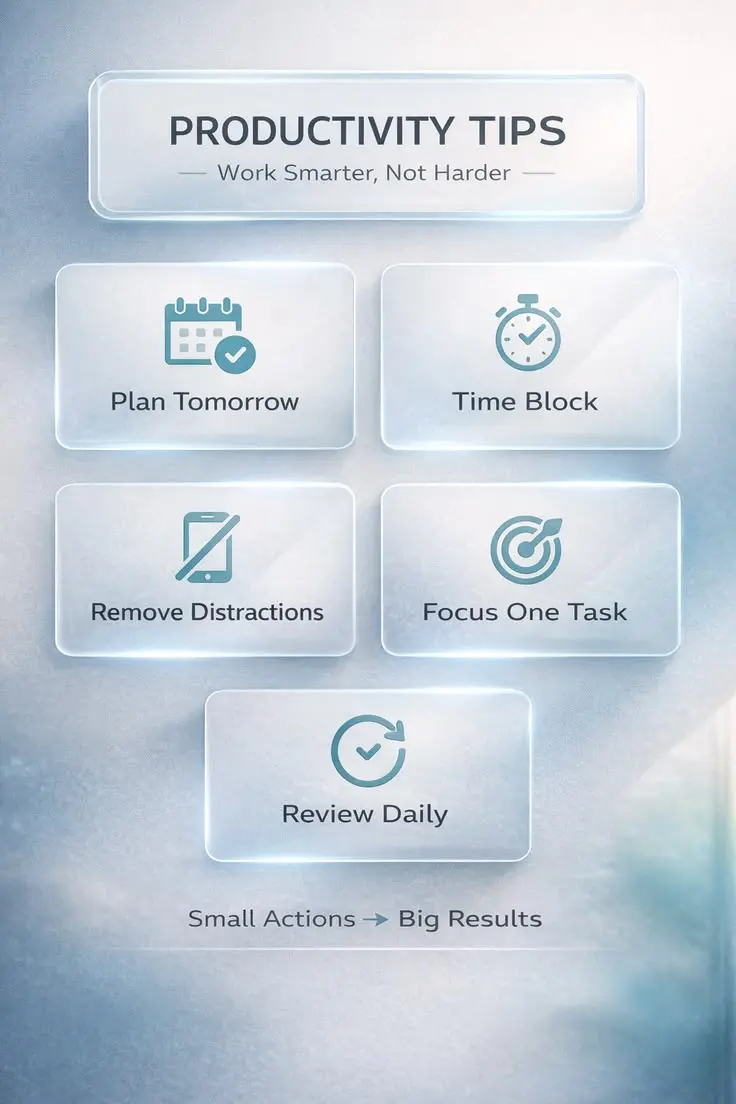
Step 2: Plan Your Day in Advance
Planning is one of the most powerful productivity tips.
Spend 10 to 15 minutes each evening planning the next day. List your top three priorities. Focus on completing those first.
You can use a notebook, planner, or digital app. The tool does not matter as much as the habit itself.
Planning helps you start your day with clarity instead of confusion.
Step 3: Use the Time Blocking Method
Time blocking means dividing your day into specific time periods for specific tasks.
For example:
- 9:00 AM – 10:00 AM: Email responses
- 10:00 AM – 12:00 PM: Project work
- 1:00 PM – 2:00 PM: Meetings
This method prevents multitasking and increases focus. When you assign time to tasks, you are more likely to complete them efficiently.
Step 4: Eliminate Distractions
Distractions reduce productivity quickly.
Common distractions include social media, phone notifications, and unnecessary conversations. To reduce them:
- Turn off non-essential notifications
- Keep your phone away during deep work
- Use noise-canceling headphones if needed
- Inform others when you need focused time
Even small changes in your environment can improve concentration.
Step 5: Apply the 80/20 Rule
The 80/20 rule suggests that 80 percent of results often come from 20 percent of efforts.
Identify the tasks that bring the most value. Focus on those first. Avoid spending too much time on minor activities that do not contribute significantly to your goals.
This principle is one of the most effective productivity tips for smarter work.
Step 6: Take Regular Breaks
Working nonstop can reduce efficiency. Short breaks refresh your mind and body.
Try the 25-5 method: work for 25 minutes, then take a 5-minute break. After four cycles, take a longer break.
Breaks prevent burnout and help maintain steady energy levels.
Step 7: Review and Reflect Daily
At the end of the day, review what you completed.
Ask yourself:
- What went well?
- What could be improved?
- What will I focus on tomorrow?
Reflection strengthens your planning skills and builds better habits over time.
Benefits of Productivity Tips
Following effective productivity tips offers many advantages:
- Better time management
- Reduced stress and anxiety
- Improved focus and concentration
- Higher work quality
- Faster goal achievement
- Increased self-discipline
- Better work-life balance
- More free time for personal growth
- Greater sense of accomplishment
- Stronger professional reputation
These benefits compound over time, creating long-term success.
Disadvantages / Risks
Although productivity tips are helpful, there are potential risks if misused:
- Over-planning can delay action
- Obsessing over efficiency may cause stress
- Ignoring rest can lead to burnout
- Comparing productivity with others may reduce motivation
- Setting unrealistic schedules can cause frustration
Balance is essential. Productivity should improve your life, not control it.
Common Mistakes to Avoid
Many people try productivity tips but fail due to common mistakes.
First, trying too many strategies at once. Focus on one or two methods and master them.
Second, multitasking. It may feel efficient, but it reduces quality and focus.
Third, not setting priorities. Without clear priorities, you waste time on low-value tasks.
Fourth, ignoring personal energy levels. Schedule demanding tasks during your peak energy hours.
Finally, giving up too soon. Habits take time to develop. Stay consistent and patient.
Avoiding these mistakes will help you see better results.
FAQs
1. How can beginners start improving productivity?
Beginners should start with simple steps. Create a daily to-do list with three main tasks. Focus on completing them before moving to other activities. Gradually add more advanced techniques as you gain confidence.
2. How many productivity tips should I use at once?
It is best to start with one or two methods. For example, begin with daily planning and time blocking. Once they become habits, you can add other strategies.
3. Can productivity tips reduce stress?
Yes. When you manage tasks effectively, you avoid last-minute pressure. Planning and prioritizing reduce uncertainty and improve mental clarity.
4. What if I feel unmotivated?
Motivation comes and goes. Instead of waiting for motivation, focus on discipline. Start with small tasks to build momentum. Completing even one task can boost your mood.
5. Are productivity tips useful for students?
Absolutely. Students can use these methods to manage study time, complete assignments on schedule, and prepare for exams efficiently. Time blocking and goal setting are especially helpful.
6. How long does it take to see results?
You may notice improvements within a few days. However, lasting change usually takes a few weeks of consistent practice. Patience is important.
7. Is multitasking effective?
Research shows that multitasking often reduces efficiency. It is better to focus on one task at a time and complete it before moving on.
8. Can productivity tips improve work-life balance?
Yes. When you complete important tasks faster, you free up time for family, hobbies, and relaxation. Better planning creates more personal time.
Expert Tips & Bonus Points
To take your productivity to the next level, consider these expert suggestions.
First, match tasks with energy levels. Do creative or complex work when your mind is fresh. Save simple tasks for later in the day.
Second, use the two-minute rule. If a task takes less than two minutes, complete it immediately. This prevents small tasks from piling up.
Third, maintain a clean workspace. A clutter-free desk reduces distractions and improves focus.
Fourth, practice saying no. Protect your time by avoiding unnecessary commitments.
Fifth, track your progress weekly. Review completed tasks and celebrate improvements.
You can also use visual reminders such as sticky notes or goal boards. Seeing your goals daily keeps you motivated.
Finally, prioritize health. Regular exercise, proper sleep, and healthy meals improve concentration and energy. Physical well-being supports mental productivity.
Conclusion
Improving your daily output does not require extreme changes. Simple productivity tips, practiced consistently, can transform your routine and results.
Start by setting clear goals. Plan your day in advance. Eliminate distractions and focus on high-value tasks. Take regular breaks and review your progress. These small steps create powerful momentum.
Remember, productivity is not about constant activity. It is about meaningful progress. When you manage your time wisely, you reduce stress and gain more control over your life.
Be patient with yourself. Developing new habits takes time. Some days will be more productive than others, and that is normal. What matters most is staying committed to improvement.