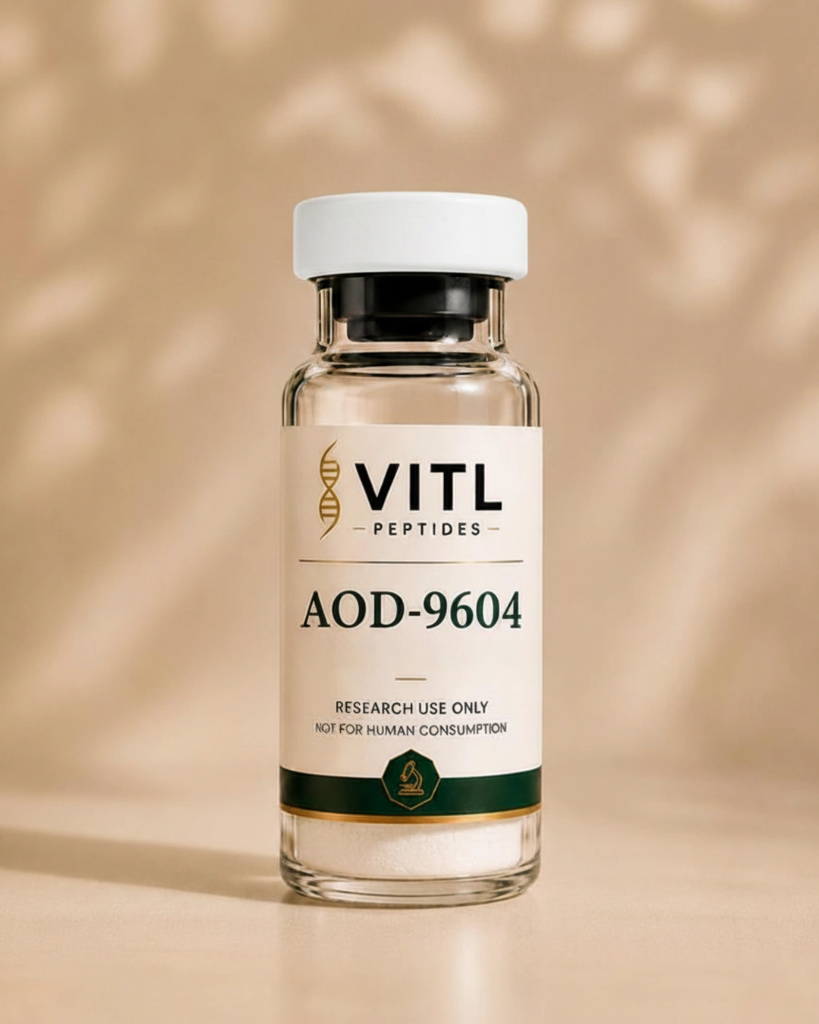
Peptide science involves studying how amino acid sequences form different molecular structures and contribute to biological processes. Human growth hormone is a well-known example of a larger protein hormone, while AOD-9604 represents a much shorter synthetic peptide analogue derived from a specific region of its structure. Although these molecules share a structural relationship, they are not chemically identical. Vitl Peptides provides research-focused product information for those interested in understanding specialised peptide compounds.
Understanding the differences between an AOD-9604 research peptide and full-length growth hormone requires examining their molecular composition, structural characteristics, and research backgrounds. These distinctions are important when evaluating scientific literature and selecting research materials.
What Is Full-Length Human Growth Hormone?
Human growth hormone (hGH), also known as somatotropin, is a protein hormone naturally produced by the pituitary gland. It consists of 191 amino acids arranged into a specific three-dimensional structure. Its molecular complexity allows it to participate in several biological signalling processes.
Molecular Composition of Growth Hormone
Full-length human growth hormone contains 191 amino acids and has a molecular mass of approximately 22 kilodaltons. Its structure includes multiple regions that contribute to its overall molecular organisation.
The amino acid sequence forms a folded protein structure maintained by chemical interactions and disulfide bonds. These structural features are important when studying how the complete hormone interacts with its biological targets.
Some key characteristics include:
- A total of 191 amino acids.
- A relatively large protein structure.
- A defined three-dimensional molecular arrangement.
- Multiple structural regions contributing to its activity.
- Interaction with growth hormone receptors.
These characteristics distinguish full-length growth hormone from shorter synthetic peptide fragments. Understanding its composition provides a useful foundation for comparing it with an AOD-9604 research peptide.
Biological Signalling and Research Context
Full-length growth hormone participates in biological signalling through interactions with growth hormone receptors. These interactions contribute to downstream signalling pathways, including processes associated with the insulin-like growth factor system.
Researchers study these mechanisms to understand hormone signalling, protein interactions, and related biochemical processes. Investigations may examine receptor binding, cellular responses, and molecular communication.
Because full-length growth hormone contains the complete amino acid sequence, its biological activity cannot automatically be attributed to any single fragment. This distinction is essential when comparing different growth hormone-related research materials.
What Is AOD-9604?
AOD-9604 is a synthetic peptide analogue associated with the C-terminal region of human growth hormone. Unlike the complete hormone, it contains only 16 amino acids and has an additional N-terminal tyrosine modification.
Understanding Its Shorter Peptide Sequence
The AOD-9604 sequence is commonly represented as YLRIVQCRSVEGSCGF. It corresponds to human growth hormone residues 177–191, with an additional tyrosine at the beginning of the sequence.
Two cysteine residues form a disulfide bond, creating a cyclic structural arrangement. This modification contributes to its distinct molecular identity and differentiates it from the corresponding unmodified native fragment.
The AOD-9604 research peptide is therefore not simply a smaller version of the complete growth hormone molecule. It is a specifically designed synthetic analogue with its own sequence and structural characteristics.
Why Was AOD-9604 Developed?
AOD-9604 originated from scientific investigations into the C-terminal region of human growth hormone. Researchers explored whether selected molecular regions could be investigated separately from the larger hormone structure.
This approach generated interest in the relationship between peptide structure and specific biochemical pathways. It also provided an example of how synthetic modifications can create research compounds with distinct molecular characteristics.
Importantly, the original scientific hypothesis does not establish clinical effectiveness. Research findings must be considered according to the experimental models, methods, and outcomes actually studied.
Key Differences Between AOD-9604 and Full-Length Growth Hormone
Although both molecules have a structural relationship, their differences extend beyond molecular size. Their amino acid sequences, molecular organisation, and research characteristics are not the same.
Comparing Molecular Structure and Composition
The most noticeable difference is the number of amino acids. Full-length human growth hormone contains 191 amino acids, while AOD-9604 contains 16.
Their structural differences can be summarised as follows:
- Full-length growth hormone is a complete protein hormone.
- AOD-9604 is a synthetic 16-amino-acid peptide analogue.
- AOD-9604 represents a modified C-terminal region of growth hormone.
- Its sequence includes an additional N-terminal tyrosine.
- The peptide has a cyclic structure formed through a disulfide bond.
These distinctions matter when reviewing analytical data and scientific publications. An AOD-9604 research peptide must be identified according to its specific molecular composition rather than being treated as identical to the complete hormone.
Differences in Research Investigations
Full-length growth hormone has an extensive research history involving hormone receptors, cellular signalling, and physiological processes. AOD-9604 has a more specialised research background centred on investigations of its modified peptide structure and proposed biochemical properties.
Researchers have examined AOD-9604 in preclinical models to investigate selected metabolic pathways. Human research has also been conducted, although the available evidence does not establish it as an effective treatment for weight management or another medical condition.
This distinction is important because the research history of a complete hormone cannot simply be transferred to a shorter peptide analogue. Each compound requires independent evaluation.
Why AOD-9604 Attracts Scientific Interest
The scientific interest in AOD-9604 comes from the broader question of whether specific regions of larger protein hormones can be studied independently. Its structure provides a useful example of peptide modification and targeted biochemical investigation.
Exploring Peptide Structure and Function
Peptide research often investigates how specific amino acid sequences influence molecular characteristics. Researchers may examine the relationship between sequence length, structural arrangement, and interactions with selected biological components.
An AOD-9604 research peptide offers a specialised example because it retains a defined region associated with human growth hormone while having a substantially shorter structure.
Scientific investigations may consider:
- Sequence-specific molecular characteristics.
- Peptide conformation and structural stability.
- Chemical identity and purity.
- Interactions examined in controlled experimental systems.
- Differences between modified and full-length molecules.
These investigations help expand scientific understanding of peptide chemistry. However, structural similarities alone do not prove that two compounds share the same biological effects.
Understanding the Limits of Existing Evidence
Research findings should always be interpreted according to their evidence level. Laboratory studies, animal experiments, and human clinical trials provide different types of information and cannot be considered interchangeable.
For example, preclinical observations involving AOD-9604 do not establish that the compound has demonstrated clinical benefits. Its research history also includes a human development programme that did not establish the intended weight-management efficacy.
Researchers evaluating AOD-9604 laboratory research should therefore distinguish experimental hypotheses from confirmed findings. This approach supports more accurate scientific communication and avoids overstating the significance of preliminary results.
Evaluating AOD-9604 Laboratory Research Materials
Selecting research materials involves checking product identity, analytical quality, and supporting documentation. These considerations are particularly important for synthetic peptides, where sequence accuracy and chemical integrity influence the reliability of laboratory investigations.
Checking Purity and Analytical Documentation
A Certificate of Analysis (COA) can provide useful batch-specific information about a peptide material. Depending on the testing performed, it may include identity information, purity measurements, and analytical results.
When reviewing AOD-9604 laboratory research materials, researchers should consider:
- Whether the peptide sequence is clearly documented.
- Whether a batch-specific COA is available.
- Whether HPLC results support the reported purity.
- Whether molecular identity is supported by appropriate testing.
- Whether storage and handling information is accessible.
These checks help researchers assess the available evidence about a product’s quality. A purity claim should always be considered alongside the analytical method used.
Selecting a Research-Focused Supplier
A suitable research supplier should provide clear product specifications and accessible technical information. Researchers should be able to understand the material’s identity, intended classification, and applicable handling requirements.
Vitl Peptides provides research-focused product information for AOD-9604 and other peptide materials. Those exploring AOD-9604 laboratory research can review available product specifications and documentation when assessing research materials.
All materials should be handled according to supplier instructions and appropriate laboratory safety procedures. Research-use-only products are not intended for human or veterinary consumption.
Conclusion
AOD-9604 and full-length human growth hormone share a structural relationship, but they are significantly different in molecular composition and research characteristics. Full-length growth hormone is a 191-amino-acid protein, whereas AOD-9604 is a synthetic 16-amino-acid peptide analogue with an additional tyrosine modification.
Understanding these differences is essential when examining peptide research, interpreting scientific findings, and evaluating an AOD-9604 research peptide. AOD-9604 laboratory research also demonstrates why experimental evidence must be assessed independently for each compound.
Vitl Peptides provides research-focused product information to support the evaluation of peptide materials. Accurate molecular identification, transparent analytical documentation, and responsible research practices remain central to informed scientific investigation.